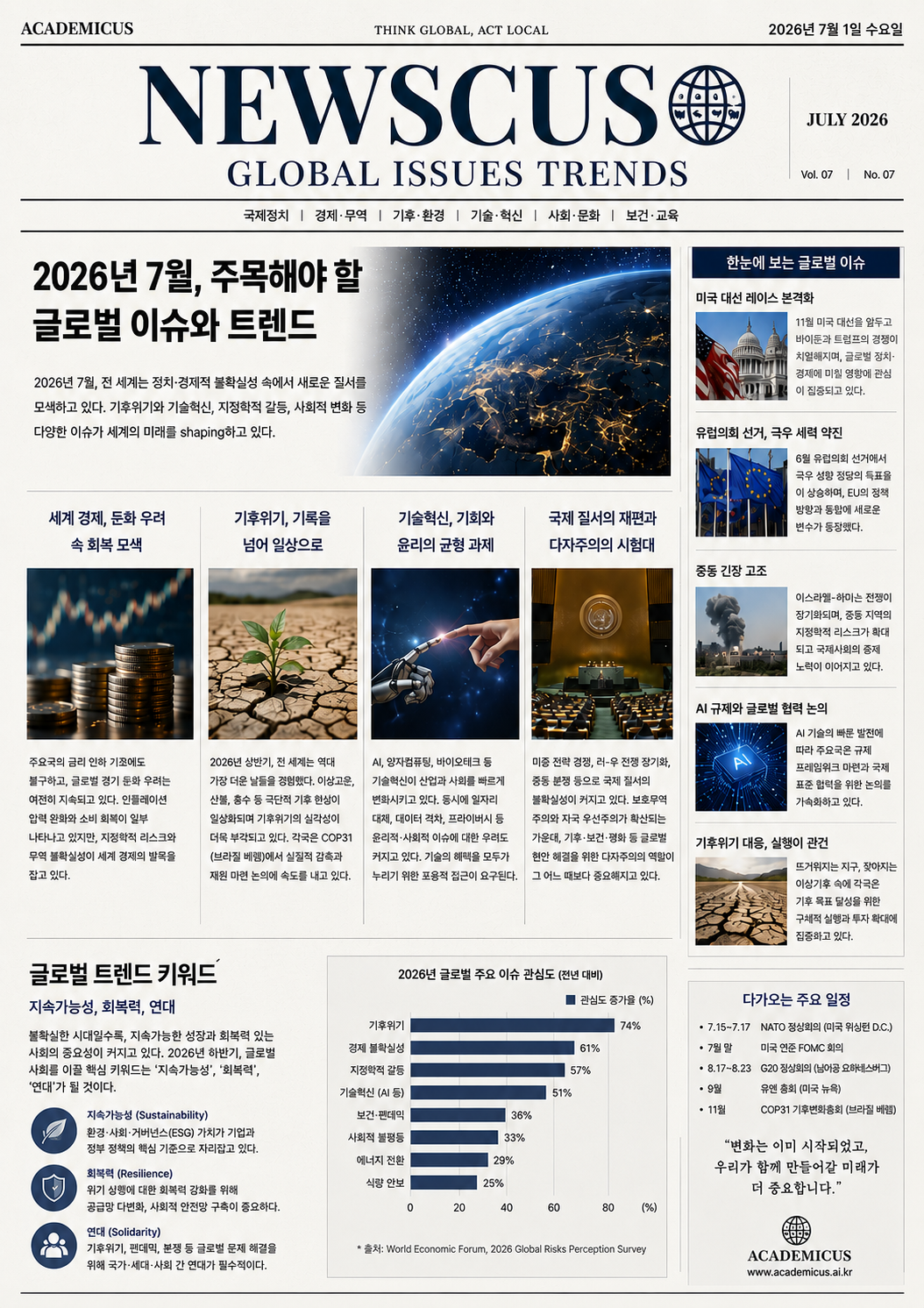

7월 국제 이슈 및 트렌드(국내·해외 종합)


✅ One-line key summary(한 줄 핵심 정리)
AI infrastructure investment, global tariff disputes, semiconductor industry growth, and energy security are emerging as the key drivers shaping today’s economic and social landscape.
(AI 인프라 투자, 글로벌 관세 전쟁, 반도체 성장, 에너지 안보가 경제·사회 이슈를 주도하고 있음.)

🌐Domestic Issues (Korea)(국내 이슈)
1. Intensifying Competition in National AI Infrastructure Investment(AI 국가 인프라 투자 경쟁 본격화)
- The Korean government and major domestic corporations are accelerating large-scale investments in AI infrastructure, including AI data centers, semiconductor clusters, and power grid development, signaling the beginning of a full-scale race to strengthen the nation’s AI capabilities.(정부와 국내 대기업들이 AI 데이터센터, 반도체 클러스터, 전력망 구축에 대규모 투자를 발표하며 AI 인프라 경쟁이 본격화되고 있음. )
- SK Group has announced significant investments in AI data centers and semiconductor supply chains, while expanding national AI computing capacity has emerged as a key government policy priority.(SK그룹은 AI 데이터센터와 반도체 공급망에 대규모 투자를 발표했으며, 국가 차원의 AI 컴퓨팅 역량 확대가 핵심 정책 과제로 부상함.)
- This is particularly important because the competitiveness of the AI industry depends not only on AI services themselves, but also on securing the underlying infrastructure that supports them, such as data centers, electricity supply, and semiconductor manufacturing capabilities.(AI 산업의 경쟁력은 단순한 AI 서비스가 아니라 데이터센터·전력·반도체 등 기반 인프라 확보 여부에 달려 있기 때문에 중대사항임.)
2. Ongoing Korea–U.S. Trade and Tariff Risks(한미 통상·관세 리스크 지속)
- Uncertainty continues to grow for Korean exporters as the United States strengthens its protectionist trade policies and discusses new tariff frameworks.(미국의 보호무역 강화와 새로운 관세 체계 논의가 이어지면서 한국 수출 기업들의 불확실성이 확대되고 있음.)
- Key export-oriented industries—including steel, semiconductors, and automobiles—are expected to be among the sectors most affected by potential changes in trade regulations and tariff policies.(철강·반도체·자동차 등의 주력 산업이 주요 영향을 받을 가능성이 제기됨.)
- This is a critical issue because the Korean economy is highly dependent on exports. As a result, changes in tariffs and trade policies can have a direct impact on corporate investment decisions, export competitiveness, and overall economic growth.(한국 경제는 수출 의존도가 높아 관세 변화가 기업 투자와 경제 성장에 직접적인 영향을 주므로 중대사항임.)
3. Recovery in Semiconductor Exports(반도체 수출 회복세)
- Semiconductors have been identified as the industry with the strongest growth outlook in export market forecasts for the third quarter of 2026.(2026년 3분기 수출경기전망에서 반도체가 가장 높은 성장 기대 업종으로 평가됨.)
- Demand for memory chips used in AI servers, as well as high-performance storage devices, continues to increase, driven by the rapid expansion of AI-related investments and data-intensive applications.(AI 서버용 메모리와 고성능 저장장치 수요가 지속적으로 증가하고 있음.)
- This is a significant development because semiconductors are a cornerstone of South Korea’s export economy and serve as a key indicator of the country’s overall economic recovery and industrial competitiveness.(반도체는 한국 수출의 핵심 산업이며 경기 회복 여부를 판단하는 대표 지표이므로 중대사항임.)

🌍Global Issues(해외 이슈)
1. AI-Driven Inflation(AI발(發) 인플레이션(AI-flation))
- As global technology giants continue to make massive investments in building AI data centers, prices for semiconductors, electricity, and electronic equipment are rising due to increasing demand. Experts have coined the term “AI-flation” (AI + Inflation) to describe this emerging phenomenon.(글로벌 빅테크 기업들이 AI 데이터센터 구축에 천문학적 투자를 진행하면서 반도체·전력·전자제품 가격이 상승하는 현상이 나타나고 있고, 전문가들은 이를 “AI플레이션(AI+Inflation)”으로 부르고 있음.)
- This is a significant issue because the AI industry is not only becoming a major engine of economic growth but is also emerging as an important factor influencing inflation and overall economic conditions worldwide.(AI 산업이 새로운 성장동력인 동시에 물가상승을 유발하는 경제 변수로 떠오르고 있기 때문에 중대사항임.)
2. Intensifying U.S.–China Technological Rivalry(미·중 기술 패권 경쟁 심화)
- Competition between the United States and China continues to escalate across strategic industries, including semiconductors, rare earth minerals, artificial intelligence, and battery supply chains.(반도체·희토류·AI·배터리 공급망을 둘러싼 미국과 중국의 경쟁이 계속 확대되고 있음.)
- More recently, copper, advanced manufacturing, and supply chain controls have emerged as new areas of contention, further expanding the scope of the technological and economic rivalry between the two countries.(최근에는 구리, 첨단 제조업, 공급망 통제가 새로운 갈등 분야로 부상하고 있음.)
- This is a significant issue because U.S.–China tensions have become a key factor shaping global investment strategies, supply chain structures, and long-term business decisions for multinational companies worldwide.(미·중 갈등은 글로벌 기업의 투자 전략과 공급망 구조를 결정하는 핵심 변수이므로 중대사항임.)
3. Middle East Risks and the Energy Market(중동 리스크와 에너지 시장)
- Following the tensions between the United States and Iran, concerns over the stability of the Strait of Hormuz remain a major factor influencing the global energy market.(미국-이란 갈등 이후 호르무즈 해협의 안정성 문제가 여전히 국제 에너지 시장의 주요 변수로 남아 있음.)
- At the same time, volatility in global logistics costs and crude oil prices continues to attract close attention from governments, businesses, and investors around the world.(글로벌 물류비와 원유 가격 변동성도 지속적으로 주목받고 있음.)
- This is a significant issue because the Strait of Hormuz serves as one of the world’s most critical oil transportation routes, while energy prices have a direct impact on global inflation, economic growth, and overall market stability.(호르무즈 해협은 세계 원유 수송의 핵심 통로이며, 에너지 가격은 전 세계 물가와 경제에 직접적인 영향을 줌.)
4. Global Changes in the AI Labor Market(글로벌 AI 일자리 변화)
- Contrary to concerns that AI will replace jobs, recent analyses suggest that companies actively adopting AI technologies are actually increasing their hiring efforts. Many organizations now view AI proficiency and the ability to work effectively with AI tools as essential competitive advantages.(AI가 일자리를 대체한다는 우려와 달리, AI를 적극 활용하는 기업들의 채용 규모가 오히려 증가하고 있다는 분석이 나오고 있음. 기업들은 AI 활용 역량을 핵심 경쟁력으로 보고 있음.)
- This is a significant issue because AI-related skills are likely to become a fundamental requirement in the future workforce. As AI continues to transform industries and job functions, employees who can effectively leverage AI technologies will be better positioned to adapt to changing workplace demands and seize new career opportunities.(미래 노동시장에서는 AI 사용 능력이 기본 역량으로 자리잡을 가능성이 높아 중대사항임.)
Sources: 한국무역협회(KITA), 연합뉴스, SBS 뉴스, 머니투데이, 헤럴드경제, PwC Global, 글로벌이코노믹, 정부·기업 공식 발표자료 및 시장 분석 보고서 종합.