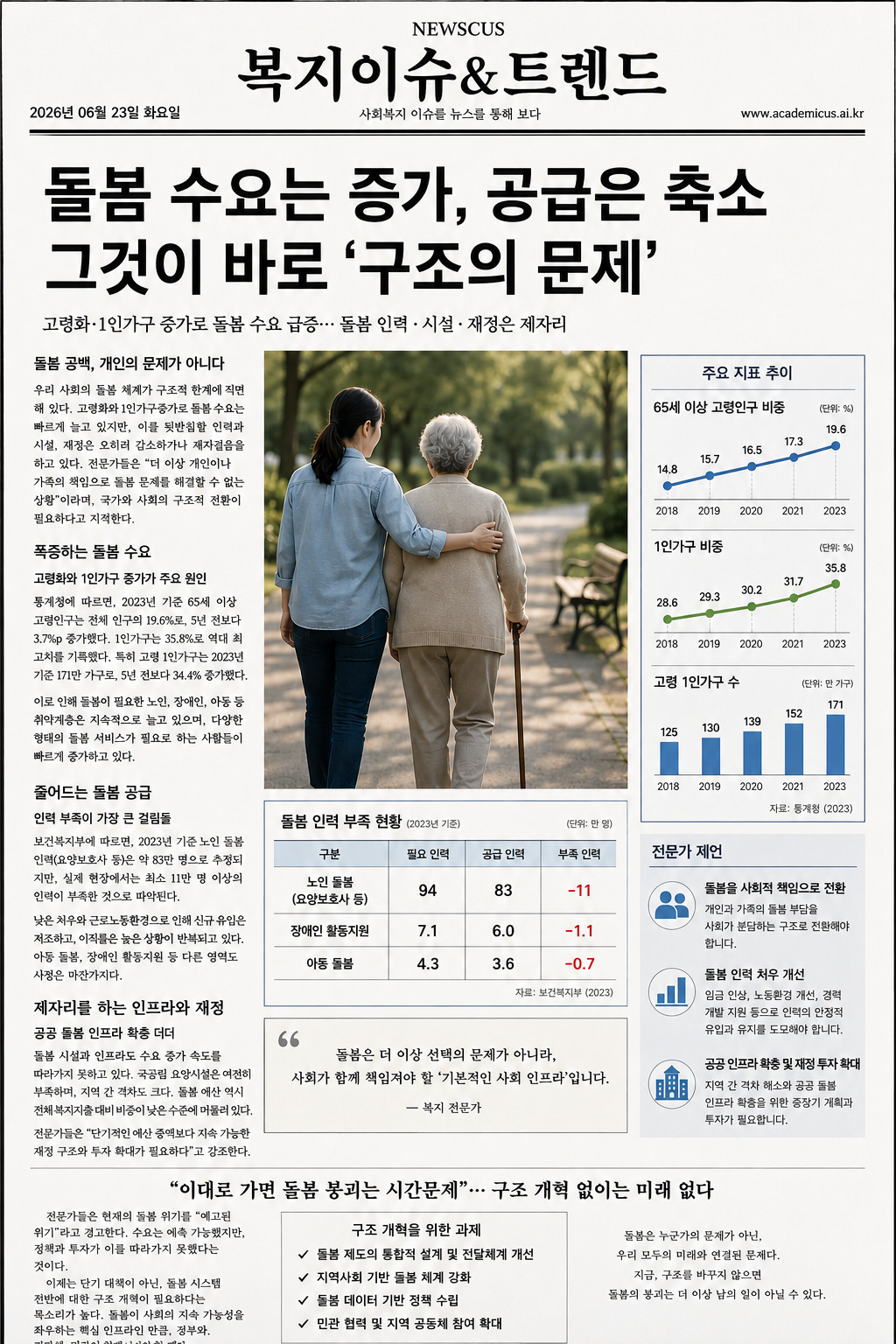
📰 NEWSCUS: Welfare Issues & Trends(복지이슈&트렌드) – Increasing demand for care, shrinking capacity — the very structure of welfare is changing.(늘어나는 돌봄, 줄어드는 여력 — 복지의 구조가 바뀌고 있다)

6월 넷째주 복지 이슈 및 트렌드 (국내·해외 종합)


📌 Domestic Welfare Issues (Korea)(국내 복지 이슈)
1. ntry into a Super-Aged Society and the Shift Toward a “Care State”(초고령사회 진입과 ‘돌봄 국가’로의 전환)
- In 2026, South Korea has officially entered a super-aged society, with demand for medical care, long-term care, and daily support rising simultaneously.(2026년 한국은 공식적으로 초고령사회에 진입하면서 의료·요양·생활 돌봄 수요가 동시에 급증하고 있음.)
- In particular, the increase in the elderly population is not merely a matter of aging, but a structural rise in the number of people who require continuous care.(특히 노인 증가는 단순 고령화 문제가 아니라 지속적인 돌봄이 필요한 인구 증가로 이어지고 있음)
→ Meaning(의미)
- Welfare is shifting from a “support policy” to a core infrastructure essential for maintaining society.(복지는 ‘지원 정책’에서 사회 유지 핵심 인프라로 변화)
- Responsibility for care is moving away from families and toward society and the state.(가족 돌봄에서 사회·국가 책임으로 이동)
→ Implications(시사점)
- This cannot be solved through financial expansion alone.(재정 확대만으로 해결 불가능)
- A comprehensive response is needed—encompassing care workforce, systems, and technology.(돌봄 인력·시스템·기술까지 포함한 종합 대응 필요)
2. Expansion of Integrated Care (Community-Based Care)통합돌봄(지역사회 중심) 본격 확대)
- From 2026, the system is shifting from hospital- and facility-centered care to home- and community-based care.(2026년부터 “병원·시설 중심에서 집·지역 중심 돌봄”으로 구조 전환)
- Medical services, long-term care, and daily support are provided in an integrated manner.(의료·요양·생활 지원을 한 번에 제공)
- Home visits and at-home nursing services are also expanding.(방문진료·재택간호 확대)
→ Meaning(의미)
- A structural transformation in the way welfare is delivered
- (“institution-centered → life-space-centered”)(복지 전달 방식 자체가 바뀌는 구조적 변화(“기관 중심 → 삶의 공간 중심”))
→ Implications(시사점)
- The role of social workers is expanding—from simple service providers to care coordinators.(사회복지사의 역할 확대 → 단순 서비스 제공 → 케어 코디네이터)
- The importance of community-based networks is increasing.(지역사회 네트워크 중요성 증가)
3. Expansion of Welfare Budget vs. Growing Fiscal Burden(복지 예산 확대 vs 재정 부담 심화)
- n 2026, the welfare and employment budget amounts to approximately 319 trillion KRW, accounting for the largest share of the total government budget.(2026년 복지·고용 예산은 약 319조원 규모로 전체 예산에서 가장 큰 비중 차지)
- Basic livelihood support has been expanded.(기초생활보장 확대)
- Support for children, the elderly, and people with disabilities has increased.(아동·노인·장애인 지원 증가)
- Welfare policies for youth and low-income groups have also been strengthened.(청년·저소득층 복지 강화)
→ Meaning(의미)
- Although welfare expansion continues, the sustainability of public finances is emerging as a key issue.(복지 확대는 계속되고 있지만 동시에 재정 지속 가능성이 핵심 문제로 등장)
→ Implications(시사점)
- Rather than “how much to provide,” the central policy question is whether the system is sustainable.(“얼마나 줄 것인가”보다 “지속 가능한 구조인가”가 정책 핵심)
- Debates over pensions, taxation, and potential welfare cuts are likely to intensify.(연금·세금·복지 축소 논쟁 확대 가능)
4. Expansion of AI-Based “Smart Welfare”(AI 기반 ‘스마트 복지’ 확대)
- Starting in 2026, South Korea is rapidly adopting AI-based welfare systems.(한국은 2026년부터 AI 기반 복지 시스템을 빠르게 도입 중)
- Automatic detection of at-risk households(위기가구 자동 탐지)
- Provision of personalized welfare services(맞춤형 복지 제공)
- Data-driven counseling and service linkage systems(데이터 기반 상담·연계 시스템)
→ Meaning(의미)
- The operation of welfare is shifting from a “people-centered” model to a data-driven system.(복지 운영 방식이 “사람 중심 → 데이터 기반 시스템”으로 전환)
→ Implications(시사점)
- There is a growing demand for professionals with both social welfare and IT competencies.(사회복지 전공 + IT 역량 요구 증가)
- The digital divide is also emerging as a new welfare issue.(디지털 격차 문제도 새로운 복지 이슈로 등장)
5. “Package-Type Welfare” (Expansion of Integrated Support)(‘패키지형 복지’ (통합 지원 확대))
- A key feature of recent policies is the shift from single-benefit support to integrated support systems.(최근 정책 특징은 단일 지원 → 통합 지원 구조)
- Income, care, housing, and medical services are provided together.(소득 + 돌봄 + 주거 + 의료 함께 제공)
- Customized, life-cycle-based welfare services are expanding.(대상 맞춤형 생애주기 복지 확대)
→ Meaning(의미)
- Welfare is no longer a set of individual policies, but a system that manages the overall quality of life.(복지는 더 이상 개별 정책이 아니라 삶 전체를 관리하는 시스템)
→ Implications(시사점)
- The demand for professional expertise among social workers is increasing.(사회복지사의 전문성 요구 상승)
- Policy design is becoming more complex.(정책 설계 복잡성 증가)
🌍 Global Welfare Issues(해외 복지 이슈)
1. Care Economy Crisis (돌봄 경제 위기)
- The key global issue in 2026 is the “surge in care demand vs. shortage of workforce.”(2026년 글로벌 핵심 이슈는 “돌봄 수요 폭증 vs 인력 부족”)
- Rapid increase in demand for elderly and childcare services(노인·아동 돌봄 수요 급증)
- Labor shortages(노동 부족) → sharp rise in costs(비용 급등)
- Turnover rate in care work reaches around 80%(돌봄 노동 이직률 약 80%)
- Low-wage structure makes it difficult to retain workers(저임금 구조로 인력 유지 어려움)
→ Meaning(의미)
- The core resource of welfare is not financial capital, but people (labor).(복지의 핵심 자원은 ‘재정’이 아니라 사람(노동력))
→ Implications(시사점)
- Welfare policy(복지 정책) = labor market policy(노동시장 정책)
- Care work will become a key industry in the future.(돌봄 노동 = 미래 핵심 산업)
- 「통합돌봄 전국 확대 관련 기사」
- KPMG, 「Mapping the Care Economy in 2026」
- 「Elder Care in 2026: Trends to Watch」
- UN, 「World Social Report 2025」