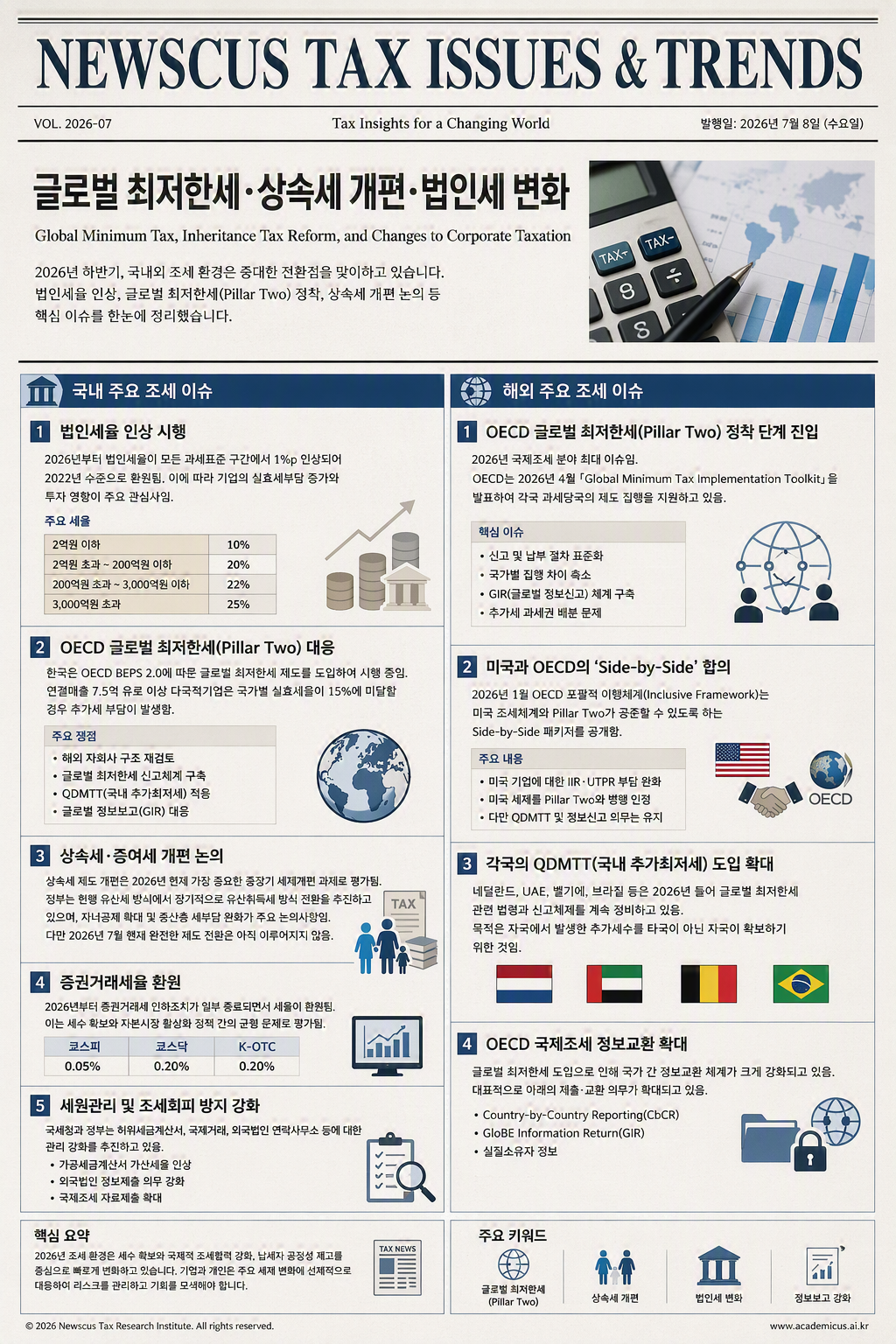
📰 NEWSCUS: Tax Issues & Trends(조세이슈&트렌드) – Global Minimum Tax, Inheritance Tax Reform, and Changes to Corporate Taxation(글로벌 최저한세·상속세 개편·법인세 변화)

7월 둘째주 조세 이슈 및 트렌드 (국내·해외 종합)


📌 Domestic Tax Issues (Korea)(국내 조세 이슈)
1. Implementation of Higher Corporate Tax Rates(법인세율 인상 시행)
Effective from 2026, Korea’s corporate income tax rates have been increased by 1 percentage point across all taxable income brackets, restoring the rates to their 2022 levels. As a result, the rise in effective tax burdens on businesses and its potential impact on investment activities have become key areas of focus.
(2026년부터 법인세율이 모든 과세표준 구간에서 1%p 인상되어 2022년 수준으로 환원됨. 이에 따라 기업의 실효세부담 증가와 투자 영향이 주요 관심사임.)
* Key Tax Rates(주요 세율)
- KRW 200 million or less(2억원 이하): 10%
- Over KRW 200 million to KRW 20 billion(2억원 초과~200억원 이하): 20%
- Over KRW 20 billion to KRW 300 billion(200억원 초과~3,000억원 이하): 22%
- Over KRW 300 billion(3,000억원 초과): 25%
2. OECD Pillar Two (Global Minimum Tax) Compliance(OECD 글로벌 최저한세(Pillar Two) 대응)
South Korea has implemented the OECD BEPS 2.0 Global Minimum Tax regime. Under the rules, multinational enterprise (MNE) groups with consolidated annual revenue of at least EUR 750 million may be subject to additional taxation if their effective tax rate in a particular jurisdiction falls below 15%.
(한국은 OECD BEPS 2.0에 따른 글로벌 최저한세 제도를 도입하여 시행 중임, 연결매출 7.5억 유로 이상 다국적기업은 국가별 실효세율이 15%에 미달할 경우 추가세 부담이 발생함.)
* Key Issues(주요 쟁점)
- Review and restructuring of overseas subsidiary arrangements(해외 자회사 구조 재검토)
- Establishment of a Global Minimum Tax compliance and reporting framework(글로벌 최저한세 신고체계 구축)
- Application of the Qualified Domestic Minimum Top-up Tax (QDMTT)(QDMTT(국내 추가최저세) 적용)
- Compliance with Global Information Return (GIR) reporting requirements(글로벌 정보보고(GIR) 대응)
3. Inheritance and Gift Tax Reform Discussions(상속세·증여세 개편 논의)
Inheritance tax reform is considered one of the most significant medium- to long-term tax policy issues in South Korea as of 2026.(상속세 제도 개편은 2026년 현재 가장 중요한 중장기 세제개편 과제로 평가됨.)
The government is pursuing a long-term transition from the current estate tax system, under which tax is imposed on the deceased’s total estate, to an inheritance acquisition tax system, under which tax is levied based on the assets actually received by each heir. Key discussion points include expanding child-related deductions and reducing the tax burden on middle-income households. However, as of July 2026, a full transition to the new system has not yet been implemented.
(정부는 현행 유산세 방식에서 장기적으로 유산취득세 방식 전환을 추진하고 있으며, 자녀공제 확대 및 중산층 세부담 완화가 주요 논의사항임, 다만 2026년 7월 현재 완전한 제도 전환은 아직 이루어지지 않음.)
4. Restoration of Securities Transaction Tax Rates(증권거래세율 환원)
Beginning in 2026, the previously reduced securities transaction tax rates have been partially restored following the expiration of certain tax reduction measures. This change is viewed as an effort to strike a balance between securing government revenue and promoting capital market development.
(2026년부터 증권거래세 인하조치가 일부 종료되면서 세율이 환원됨. 이는 세수 확보와 자본시장 활성화 정책 간의 균형 문제로 평가됨.)
- KOSPI(코스피): 0.05%
- KOSDAQ(코스닥): 0.20%
- K-OTC: 0.20%
5. Strengthening Tax Administration and Anti-Tax Avoidance Measures(세원관리 및 조세회피 방지 강화)
The National Tax Service (NTS) and the government are strengthening oversight of false tax invoices, international transactions, and liaison offices of foreign corporations.
(국세청과 정부는 허위세금계산서, 국제거래, 외국법인 연락사무소 등에 대한 관리 강화를 추진하고 있음.)
- Increased penalty rates for fraudulent tax invoices(가공세금계산서 가산세율 인상)
- Enhanced information filing requirements for foreign corporations(외국법인 정보제출 의무 강화)
- Expanded documentation and reporting requirements for international taxation matters(국제조세 자료제출 확대)
🌍 Global Tax Issues(해외 조세 이슈)
1. OECD Global Minimum Tax (Pillar Two) Enters the Implementation Phase(OECD 글로벌 최저한세(Pillar Two) 정착 단계 진입)
The OECD Global Minimum Tax (Pillar Two) remains the most significant international tax issue in 2026.(2026년 국제조세 분야 최대 이슈임.)
In April 2026, the OECD released the Global Minimum Tax Implementation Toolkit to support tax authorities worldwide in administering and enforcing the regime.(OECD는 2026년 4월 「Global Minimum Tax Implementation Toolkit」을 발표하여 각국 과세당국의 제도 집행을 지원하고 있음.)
* Key Issues(핵심 이슈):
- Standardization of tax filing and payment procedures(신고 및 납부 절차 표준화)
- Reduction of differences in implementation across jurisdictions(국가별 집행 차이 축소)
- Establishment of the Global Information Return (GIR) framework(GIR(글로벌 정보신고) 체계 구축)
- Allocation of taxing rights over top-up taxes(추가세 과세권 배분 문제)
2. OECD and U.S. Reach a “Side-by-Side” Agreement(미국과 OECD의 ‘Side-by-Side’ 합의)
In January 2026, the OECD Inclusive Framework released the Side-by-Side Package, which allows the U.S. tax system and the Pillar Two framework to coexist.
(2026년 1월 OECD 포괄적 이행체계(Inclusive Framework)는 미국 조세체계와 Pillar Two가 공존할 수 있도록 하는 Side-by-Side 패키지를 공개함.)
* Key Features(주요 내용):
- Reduced IIR (Income Inclusion Rule) and UTPR (Undertaxed Profits Rule) exposure for U.S. multinational enterprises(미국 기업에 대한 IIR·UTPR 부담 완화)
- Recognition of the U.S. tax system as operating alongside Pillar Two(미국 세제를 Pillar Two와 병행 인정)
- Continued application of QDMTT and information reporting obligations(다만 QDMTT 및 정보신고 의무는 유지)
3. Expansion of QDMTT (Qualified Domestic Minimum Top-up Tax) Adoption(각국의 QDMTT(국내 추가최저세) 도입 확대)
Countries including the Netherlands, the UAE, Belgium, and Brazil have continued to refine their legislation and reporting frameworks related to the Global Minimum Tax throughout 2026.
(네덜란드, UAE, 벨기에, 브라질 등은 2026년 들어 글로벌 최저한세 관련 법령과 신고체계를 계속 정비하고 있음.)
The objective is to ensure that additional tax revenues arising within a jurisdiction are collected domestically rather than being allocated to other countries.
(목적은 자국에서 발생한 추가세수를 타국이 아닌 자국이 확보하기 위한 것임.)
4. Expansion of OECD International Tax Information Exchange(OECD 국제조세 정보교환 확대)
The introduction of the Global Minimum Tax has significantly strengthened international information exchange frameworks among tax authorities.(글로벌 최저한세 도입으로 인해 국가 간 정보교환 체계가 크게 강화되고 있음.)
In particular, filing and information exchange obligations have been expanded for(대표적으로 아래의 제출·교환 의무가 확대되고 있음.)
- Country-by-Country Reporting(CbCR)
- GloBE Information Return(GIR)
- Beneficial Ownership Information(실질소유자 정보)
- 김·장 법률사무소 「2026년 세법 및 시행령 개정사항의 주요 내용」 – 법인세율 인상, 증권거래세 환원, 국제조세 및 VAT 개정사항 정리.
- 택스넷 「2026년 주요 세법 개정안」 – 2026년 세법 개정 핵심 내용 및 기업·개인 세제 변화 해설.
- OECD 「Economic Impact Assessment of the Global Minimum Tax 2026」 – 글로벌 최저한세(Pillar Two)의 경제적 영향 및 도입 현황 분석.
- OECD Forum on Tax Administration 「Global Minimum Tax Implementation Toolkit」 – 글로벌 최저한세 집행 및 신고체계 구축을 위한 가이드라인.
- OECD Pillars Tracker 2026 – 국가별 QDMTT(국내 추가최저세) 도입 및 Pillar Two 시행 동향 정리.
- Grant Thornton 「OECD Side-by-Side Pillar 2 Deal」 – 미국과 OECD 간 Side-by-Side 합의의 주요 내용 및 영향 분석.
- RSM US 「OECD’s Side-by-Side Package」 – 미국 다국적기업에 대한 Pillar Two 세이프하버 및 과세 영향 설명.
- Bipartisan Policy Center 「International Tax Policy: Where the U.S. Stands and What’s Ahead in 2026」 – 미국 국제조세 정책과 OECD 합의 배경 분석.
- Forvis Mazars Korea 「Inheritance & Gift Tax Essentials」 – 2026년 상속·증여세 제도 및 개편 논의 주요 내용 정리.
- OECD FAQ 및 GloBE Information Return(GIR) 자료 – 글로벌 최저한세 신고 및 국제 정보교환 의무 관련 최신 지침.


