

6월 둘째주 복지 이슈 및 트렌드 (국내·해외 종합)

📌 Domestic Welfare Issues (Korea)(국내 복지 이슈)
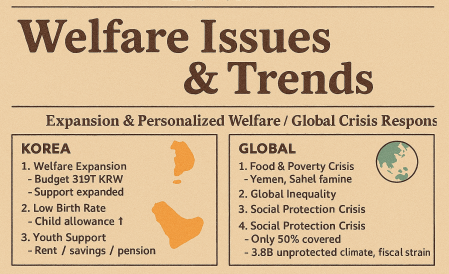
1. Continued Expansion of Welfare Policies (2026 Budget & Policy Implementation Phase)(복지 확대 기조 지속 (2026 예산 & 정책 실행 국면))
▶ “Expansion of Welfare Beneficiaries + Strengthening of Life-Centered Support”(“복지 수혜 대상 확대 + 생활밀착형 지원 강화”)
- The government maintains a record-high welfare and employment budget of approximately 319 trillion KRW(정부가 복지·고용 예산 약 319조 원으로 역대 최대 규모 유지)
- In particular(특히):
- Record-high increases in basic livelihood benefits and median income(생계급여·중위소득 역대 최대 인상)
- Expansion of support for low-income groups (estimated additional 40,000 beneficiaries)(저소득층 수급 대상 확대 (약 4만 명 추가 예상))
2. Strengthening Welfare Policies to Address Low Birth Rates(저출산 대응 복지 강화)
▶ “Enhanced Cash-Based Childcare Support → Policies to Encourage Childbirth”(“현금성 육아 지원 강화 → 출산 유도 정책”)
- Expansion of eligibility for child allowance (up to age 8)(아동수당 지급 대상 확대 (만 8세 이하))
- Increase in parental benefits(부모급여 인상):
- 1.2 million KRW per month for children aged 0(0세 월 120만 원)
- 600,000 KRW per month for children aged 1(1세 월 60만 원)
3. Expansion of Tailored Support for Youth and Vulnerable Groups(청년·취약계층 맞춤 지원 확대)
▶ “From Simple Assistance(단순 지원) → Toward Asset Building and Self-Reliance(자산형성·자립 중심 복지로 변화)”
- Expansion of programs such as Youth savings accounts, Housing (rent) support, National pension contributions support(청년미래적금, 월세지원, 국민연금 지원 등 확대)
- Introduction of a Basic Food Security Corner(먹거리 기본보장 코너 신설) → Providing integrated support that connects food assistance with welfare services(식품 + 복지 연계 지원)
4. Responding to Population Aging (Expansion of Elderly Welfare)(고령화 대응 (노인 복지 확대))
▶ “Pension + Employment Integrated Welfare for Older Adults”(“연금 + 일자리 결합형 노인복지”)
- Increase in basic pension benefits and expansion of eligibility(기초연금 인상 & 대상 확대)
- Expansion of senior employment opportunities up to 1.15 million jobs for older adults(노인일자리 115만 개로 확대)
5. Emergence of AI and Digital-Based Welfare(AI·디지털 기반 복지 등장)
▶ “Smart Welfare Powered by Digital and Data Technologies”(“디지털·데이터 기반 ‘스마트 복지’”)
- Use of AI(AI 활용):
- Automatic detection of households in crisis(위기가구 자동 탐지)
- Provision of personalized welfare services(맞춤형 복지 서비스 제공)
🌍 Global Welfare Issues(해외 복지 이슈)
1. Intensifying Food and Poverty Crisis (Especially in Conflict-Affected Regions) (식량·빈곤 위기 심화 (특히 분쟁 지역))
▶ “Welfare = A Matter of Survival (Food and Livelihood-Centered)”(“복지 = 생존 문제 (식량·생계 중심)”)
- Severe food insecurity and humanitarian crises continue in countries such as Yemen(예멘 등에서 심각한 식량 불안과 인도적 위기 지속)
- In the Sahel region(사헬 지역): Climate change + ongoing conflicts(기후변화 + 분쟁) → leading to widespread poverty and hunger(대규모 빈곤·기아 확산)
2. Ongoing Refugee and Migration Issues(난민·이주 문제 지속)
▶ “From Emergency Aid(긴급 지원) → Toward Long-Term Settlement and Integration(장기 정착·통합 문제로 전환)”
- Although the number of refugees has slightly decreased,
- tens of millions still remain in prolonged refugee situations(난민 수는 일부 감소했지만 여전히 수천만 명이 장기 난민 상태)
3. Growing Global Inequality(글로벌 불평등 심화)
▶ “Economic Inequality(경제 불평등) = A Key Challenge for Welfare Systems(복지 시스템의 핵심 과제)”
- The top 1% holds the majority of global wealth(상위 1%가 대부분의 부를 보유)
- Significant disparities exist between countries in terms of education, income levels(교육·소득 격차 국가 간 큰 차이)
4. Crisis in Social Protection Systems (Fiscal Pressure)(사회보장 시스템 위기 (재정 압박))
▶ “Rising Demand for Welfare, Limited Financial Resources”(“복지 수요는 증가, 재원은 부족”)
- Only about half of the global population has access to social protection(전 세계 인구 절반만 사회보장 혜택)
- Approximately 3.8 billion people remain unprotected, falling into welfare blind spots(약 38억 명은 복지 사각지대)
- Main causes(원인): Population aging(고령화), Climate change(기후변화), Deteriorating national finances(국가 재정 악화)
5. The Link Between Climate Change and Welfare(기후변화와 복지의 결합)
▶ “Climate Crisis = A New Welfare Issue”(“기후 위기 = 새로운 복지 이슈”)
- Climate shocks such as floods and droughts are increasingly linked to rising poverty and growing demand for welfare services(홍수·가뭄 등 기후 충격이 빈곤과 복지 수요 증가로 연결)
- 2026년 복지 예산 및 정책 확대 관련 자료
- 2026년 보건·복지 정책 변화 (기초연금, 부모급여 등)
- AI·생활밀착형 복지 및 제도 변화 정리
- 아동수당 확대 및 주요 복지제도 개편
- 글로벌 식량위기·빈곤·사헬지역 인도적 이슈
- 난민·이주 및 국제 인도주의 상황 (UN 뉴스)
- 글로벌 사회보장 사각지대 및 복지 위기 (UNICEF)
- 세계 불평등 구조 및 소득 격차 문제