

6월 셋째주 복지 이슈 및 트렌드 (국내·해외 종합)

📌 Domestic Welfare Issues (Korea)(국내 복지 이슈)
1. Conflict between “Welfare Expansion vs Fiscal Burden”(“복지 확대 vs 재정 부담” 갈등)
▶ (Welfare expansion continues, but fiscal pressure keeps increasing(복지 확대는 계속되지만 재정 부담 지속 증가) → debate over sustainability intensifies(지속가능성 논쟁 심화)
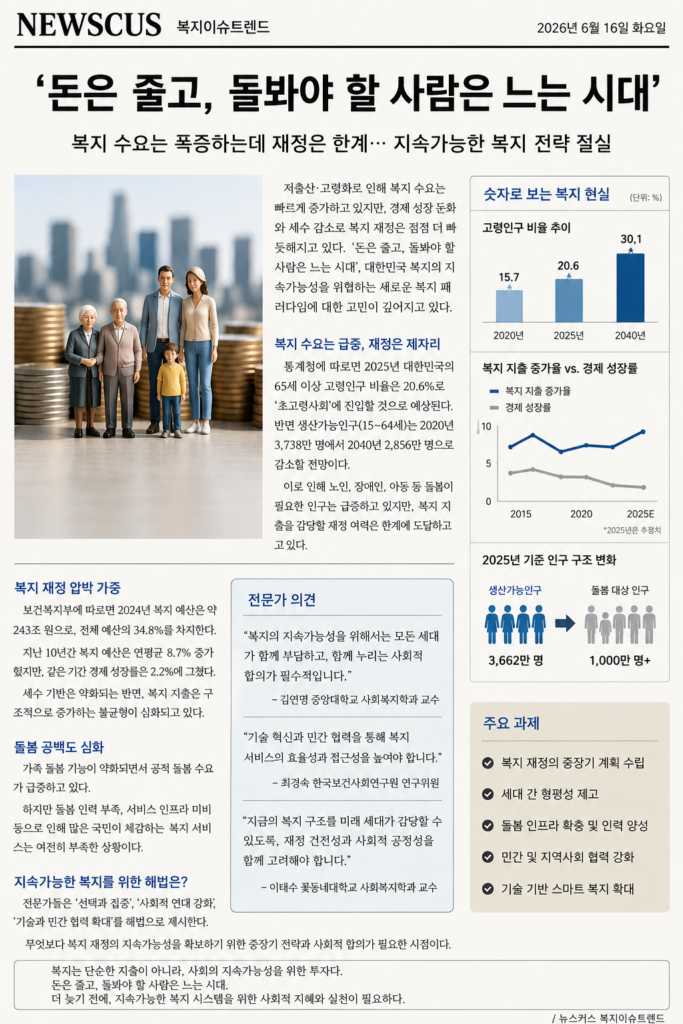
- Welfare budget continues to grow (approximately 319 trillion won in 2026)(복지 예산 계속 증가 (2026년 약 319조 규모))
- Welfare spending is projected to increase by 30% within 4 years due to aging population(고령화 영향으로 복지 지출 4년 내 30% 증가 전망)
2. Responding to an Aging Society(고령사회 대응)
▶ Shift from simple cash benefits to “care-centered welfare”(단순 현금지급 →“돌봄 중심 복지”로 전환)
- Pension reform(기초연금 개편): discussions on a structure that provides more benefits to low-income elderly(저소득 노인에게 더 많이 지급하는 구조 논의)
- Increase in reported elderly abuse cases (↑16.8%)(노인학대 신고 증가 (16.8%↑))
- Expansion of integrated care nationwide (shift from facility-based to community-based care)(통합돌봄 전국 확대 (시설 → 지역 중심 변화))
3. Changing Welfare Paradigm(복지 패러다임 변화): From Selective to Universal(선별 → 보편)
▶ Discussions on shifting toward “welfare for all”(“모두의 복지” 방향 전환 논의)
▶ Key changes(핵심 변화):
- Past(과거): Focused on vulnerable groups(취약계층 중심)
- Present(현재): Life-cycle based welfare system for the entire population(전 국민 생애주기 보장형 복지)
4. Strengthening Welfare for Youth and Low Birth Rate Response(청년·저출생 대응 복지 강화)
▶ Addressing low birth rates(저출생 대응) + supporting youth independence(청년 자립 지원) → “future-oriented welfare as an investment in the next generation”(“미래 세대 투자형 복지”)
- Expansion of youth housing support (monthly rent subsidies), savings programs, and employment assistance(청년 월세, 미래적금, 취업지원 확대)
- Expansion of child allowance eligibility (up to age 8)(아동수당 지급 연령 확대 (만 8세까지))
5. Expansion of Digital and AI-based Welfare(디지털·AI 기반 복지 확대)
▶ Data-driven welfare (smart welfare)(데이터 기반 복지 (스마트 복지))
- Identification of at-risk households using AI, and automation of welfare services(AI로 위기가구 발굴, 복지 서비스 자동화)
- Expansion of personalized welfare consultation services(맞춤형 복지 상담 확대)
6. Recent Issues (News Trends)(최근 실제 이슈 (뉴스 흐름))
▶ Increase in “everyday life–centered welfare policies”(“생활 밀착형 복지 정책” 증가)
- Launch of a nationwide pilot program for free public sanitary pads(공공생리대 전국 시범사업 시작)
- Strengthened protection for vulnerable groups during heatwaves(폭염 취약계층 보호 강화)
- Ongoing debates over medical policies, including operating room CCTV(수술실 CCTV, 의료정책 논쟁 지속)
🌍 Global Welfare Issues(해외 복지 이슈)
1. Global Welfare System Crisis(전 세계 복지 시스템 위기)
▶ “Welfare demand is increasing, but funding is insufficient”(“복지 수요는 증가, 돈은 부족”) → a common global challenge(글로벌 공통 문제)
- Rising costs(비용 ↑) + declining fiscal capacity(재정 여력 ↓) → double pressure(이중 압박)
- Only about half of the world’s population is covered by welfare systems(세계 인구 절반만 복지 보호 받음)
2. Rising Inequality & Social Polarization(불평등 확대 & 사회 양극화)
▶ Reducing inequality has become a top policy priority(불평등 완화가 최우선 정책 과제)
- Widening income gaps and increasing social instability(소득 격차 확대, 사회 불안 증가)
- Labor market(노동시장): around 400 million people facing a lack of adequate jobs(4억 명 ‘일자리 부족) 상태’
3. Changes in the Labor Structure(노동 구조 변화) → Destabilizing Welfare Systems(복지 시스템 흔들림)
▶ Collapse of the traditional “employment-based welfare system”(기존 “직장 중심 복지” 붕괴) → need for new welfare standards(새로운 복지 기준 필요)
- Growth of platform work and non-regular employment(플랫폼 노동, 비정규 증가)
- Around 2.1 billion people are engaged in informal employment(21억 명이 비공식 노동 상태)
4. Digital Transformation (Expansion of AI-driven Welfare)(디지털 전환 (AI 복지 확산))
▶ Welfare is increasingly becoming part of the “tech industry”(복지는 점점 ‘테크 산업’화)
- 64% of welfare institutions worldwide are adopting AI(전 세계 복지기관 64%가 AI 도입 진행)
▶ Applications(활용):
- Fraud detection(사기 탐지)
- Prediction of at-risk households(위기 가구 예측)
- Automated administration(자동 행정)
5. Link Between Climate Change, Refugee Issues, and Welfare(기후·난민 문제와 복지 연결)
▶ Welfare issues are no longer just domestic concerns(복지 문제가 단순 국내 문제가 아니라) → they are expanding into global humanitarian challenges(글로벌 인도주의 문제로 확대)
- 41.6 million refugees worldwide (as of 2025)(난민 4,160만 명 (2025 기준))
6. Major Policy Debates (Global Common Issues)(주요 정책 논쟁 (세계 공통))
▶ Intensifying political conflicts over the direction of welfare itself(복지 방향 자체를 두고 정치적 갈등 심화)
- Universal Basic Income (UBI)(기본소득(UBI))
- Pension reform(연금 개혁)
- Health insurance restructuring(건강보험 개편)
- Minimum wage policies(최저임금)
- EasyBib, How to Cite a Blog Post
- APA Style 공식 가이드, Blog Post References
- Scribbr, How to Cite a Website
- SurgeGraph, How to Cite a Blog Post Correctly